SECRETS OF THE EVERGLADES:
|
 |
|
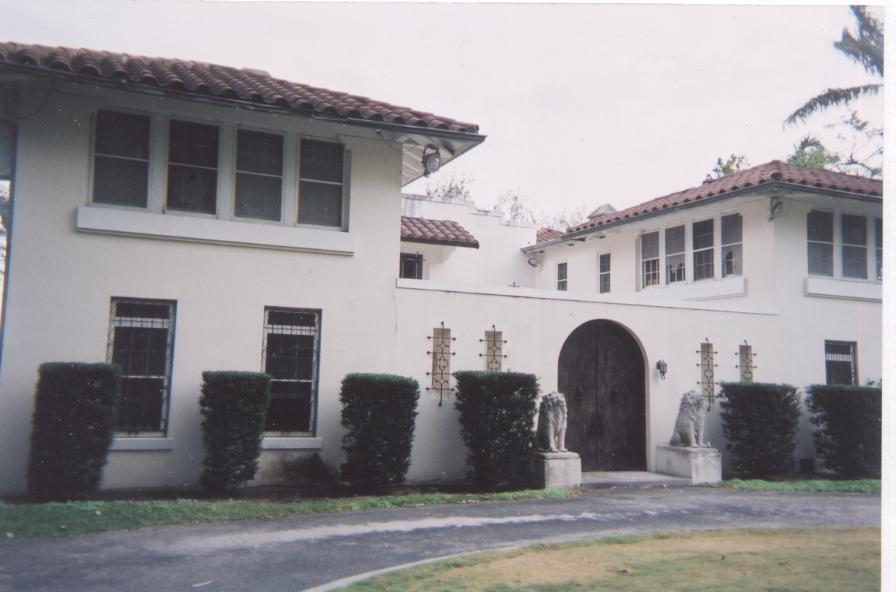
Courtesy of Jennings Heritage Project VILLA SERENA This Spanish-styled mansion was built for William Jennings Bryan and his wife, Mary, in Miami (on Biscayne Bay near present-day Coconut Grove) near his cousin, former Florida governor W.S. Jennings'esidence. Construction began in 1912. |
Environmental
Preservation Campaign
Over the years cozy relations between land companies
and state government were reinforced at the federal level, and the
project grew. However, by the late 1920’s, after two devastating
hurricanes (1926-28) which took thousands of lives, the project was
nearly bankrupt. Moreover, in 1930 , naturalists behind Florida’s
first Congresswoman Ruth Bryan Owen (William Jennings Bryan’s
daughter) fearing for the Everglades,
mounted a preservation/containment movement. Seventeen years
later during the Truman Administration (1947), the Everglades National
Park was created south of the land reclamation project. At the
dedication ceremony, both Ruth Bryan Owen and May Mann
Jennings, wife of
the late Governor Jennings (and an extraordinary civic activist in her
own right) were on the dais. 1/
The fragile ecosystems of this great park remained threatened by the massive water drainage system, and in the Clinton Administration, a huge $7.8 billion re-plumbing project was proposed by the Army Corps of Engineers (COE) and approved to redirect rainwater back into the Everglades. But after much fanfare, few outside the COE seemed pleased . The plan’s details – particularly what would happen to the water – remained vague. As Election 2000 loomed on the horizon, frantic stakeholders watched the Everglades project gather momentum.. Delicate negotiations - only a few months earlier suddenly seemed strangely out of focus.
The Phantom
Factor
Behind the formidable phalanx of EPA, the
environmental community and COE lurked a “Phantom Factor”: the
Midwest agribusiness power from Illinois, ADM, and its chairman Dwayne
O. Andreas – a longtime South Florida
resident – pushing
hard for the re-plumbing project. Perhaps
Andreas envisaged collateral benefits in crippling certain powerful
sugar interests from Palm Beach and Broward counties. As the torrent of
campaign contributions hedged on both sides, the sugar barons smelled a
rat when Enron’s subsidiary, Azurix rushed to Tallahassee with a
cockeyed scheme to sell water futures.
Water has often been a political football and bargaining chip in agriculture and land development. Some could have reasoned that the “fool’s rush” by Enron signaled something more sinister. Would farmers find thousands of acres of sugar cane, vegetables even fruit trees under water one morning – perhaps due to a technical snafu with no accountability? ..The wrong lock opened by accident?
Several days before the Election, The Washington Post carried two small stories together in its Briefs column. The first indicated that the “Everglades Bill was on course” for final approval in House/Senate conference and immediately below it was a story about USDA offering new direct subsidies to ethanol producers to purchase corn and soybeans. Coupled with the bizarre Elian Gonzalez saga, where the Clinton Justice Department seemed to be taking orders from ADM ‘s Andreas – long known for his visionary interest in normalizing trade with Cuba and modernizing the country’s sugar production (probably for a low cost ethanol feedstock) – the prize and the game itself took on clarity.
Years from now pundits and historians may still be arguing about the “cane mutiny” – the battle of agribusiness behemoths and the impact on Election 2000. But like its other many secrets, as with Osceola’s ghost, the truth will probably still be lost, running deep in the Everglades.
_____________________________________________________________
Nicholas E. Hollis is president of the Agribusiness Council (ABC), a nonprofit, tax-exempt organization formed in 1967.
References:
1/ Nelson Manfred Blake, Land into Water – Water into Land: History of Water Management in Florida, Florida State University Press, Tallahassee, (1980)
“Everglades, A Chance for Redemption,” Michael Grunwald, Washington Post , September 14, 2000
Linda D. Vance, May Mann Jennings: Florida’s Genteel Activist, University of Florida Press, 1985
Jennings Heritage Project