|
Sunrise at Trenton:
Nurturing the Revolutionary Spirit of 1776
Nicholas E. Hollis
(All Rights Reserved)
In late 1776, General George Washington’s
decision to cross the Delaware River and launch a surprise attack on
Trenton set the stage for one of the most inspiring and pivotal moments in
our Nation’s history. After suffering defeats while trying to hold New
York against a numerically superior, better equipped and more mobile
British Army under Lord Howe backed by the British Navy, Washington had
been forced into retreat across New Jersey. With morale plummeting and
enlistment papers nearly expired for many of his troops, Washington seemed
on the brink of defeat. The Redcoats (and their Hessian mercenaries)
assumed the Continental Army was in winter quarters and incapable of
mounting any type of concentrated action.1
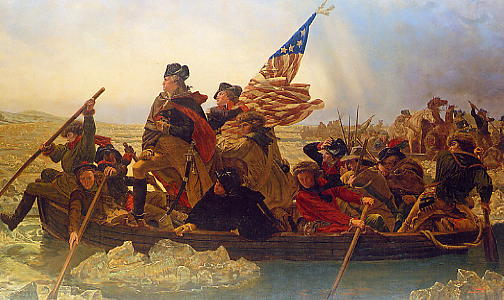 |
|
(Photo
Courtesy of Washington Crossing Foundation)
DECISIVE
WARRIOR--General Washington chose a narrow point in the Delaware
River for his crossing and surprise attack on December 26, 1776 at
Trenton. The gamble proved a turning point in America's fight for
independence (painting by Emanual Leutze completed in 1851. )

|
The daring, early morning counterattack on
December 26 caught the Hessian pickets off guard. Advancing in two columns
along the Bear Tavern (River) and the Pennington Roads, Washington’s army
swept in with a howling snow storm at their backs, surrounded the town and
positioned artillery at the head of the main streets. When the alarmed
Hessians poured out of their barracks, their attempts to organize in
formation met Colonial cannon fire and infantry with fixed bayonets on the
side streets.
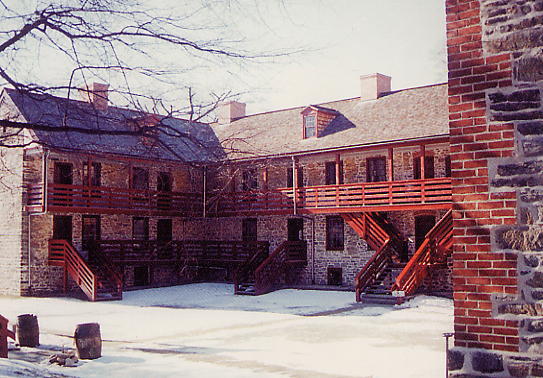 |
ALARM BELL--Hessian mercenaries
under the command of Col. Johann Rall were barracked here and at
other points around Trenton--and awoke to muster calls as the
Continental Army attacked.
|
Hessian commander Colonel Johann Gottlieb
Rall, who had performed brilliantly in capturing Fort Washington and Fort
Lee, was slow that morning in recognizing (and responding to) the growing
ferocity of the Continental attack (see Map 2). He ordered his artillery
up, but the well-situated Colonials got the best of the ensuing duel and,
with horses down, the Hessians were forced to abandon their cannon. Rall
then commanded his troops to reform outside town in an orchard for a
counterattack. But his orders to link up with other regiments (Col. Von
Lossberg and troops detached from General von Knyphausen) were confused,
and the attack floundered under pressure from American artillery barrages
on its flank. Colonel Rall was mortally wounded, and the disorganized
Hessians retreated to the orchard (Map 3). A few minutes later nearly a
thousand mercenaries surrendered. A large percentage of von Knyphausen’s
men escaped through Assunpink Creek and fled towards Princeton, but
Washington’s victory was stunning and soon electrified the country --
giving new spirit to the American cause for independence.2
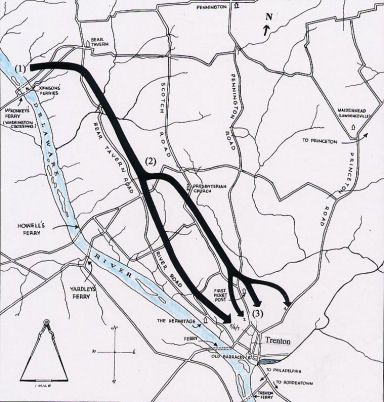 |
ATTACK AT DAWN--Featuring key road
junctions north of Trenton in 1776. (1) Washington's plans fall
behind schedule in the growing storm, but 2,400 troops and artillery
make it over the swollen Delaware River by 3 a.m. (McConkey's Ferry)
under the able direction of Henry Knox. (2) Marching silently, the
attacking Continentals divide forces with General Sullivan taking
the River Road and Generals Washington and Nathaniel Greene taking
Pennington Road. (3) Artillery positioned at the head of High and
Bridge Streets open fire just after 8 a.m., while troops under Maj.
Gen. Sullivan and Brig. Gen. St. Clair take position along side
streets near old barracks. Troops movements are concealed in the
snow, which is at the backs of the attackers.
|
At this miraculous juncture, Washington’s
army suffered only light casualties – with four wounded. The Revolutionary
War would drag on another five years to other theaters leading to
Cornwallis’ surrender at Yorktown in 1781, but Trenton was the turning
point. The significance of Washington’s dawn attack was summed up in
London by Lord George Germain, Colonial Secretary of State to King George
III in a speech before the House of Commons on May 3, 1779 when he said,
"All our hopes were blasted by that unhappy affair at Trenton."
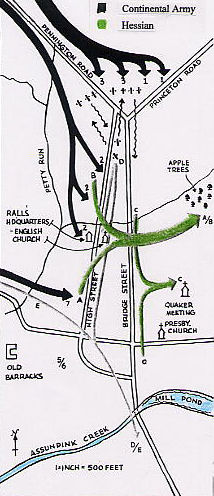 |
FIXED BAYONETS IN THE SNOW STORM (Map 2)
With Continental artillery canister clearing the
streets (1-3), Hessians are routed on the side streets by a fixed
bayonet charge under Sullivan/St. Clair (7). Amid growing confusion,
Col. Rall (A) retreats to orchard with (B) voss Lossberg regiments.
Flying snow is in their faces as Hessians organize for a
counterattack (C) Von Knyphausen's regiment moves to join Rall. |
| (Diagrams/maps
constructed courtesy of Thomas Gordon, 1828, Map of Mercer County,
New Jersey and Samuel Stelle Smith, The Battle of Trenton,
1965.) |
| |
|
| SURRENDER
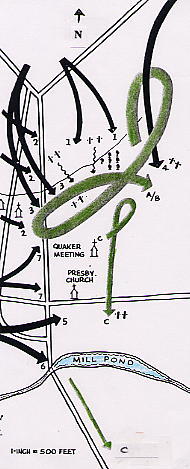
IN THE ORCHARD- (Map 3) Col. Rall's
counterattack (A/B) is shattered by enfilading artillery and musket
fire (1) directed by Brg. Gen. Stephen while Brig. Gen. Mercer's
troops (2) and Brig. Gen. Stirling's men (3) drive into the
Hessians, who retreat as Rall is hit twice and falls from his horse,
mortally wounded. Meanwhile, troops from von Knyphausen unit (C)
have moved south after misunderstanding orders. Many of these troops
eventually escape via the Assunpink Creek. (Diagrams/maps
constructed courtesy of Thomas Gordon, 1828 Map of Mercer County,
New Jersey and Samuel Stelle Smith, The Battle of Trenton, 1965) |
 |
| |
|
Dr.
Jacob Jennings of New Jersey
Marching with Washington on
that blustery morning long ago was Dr. Jacob Jennings (1744-1813), a
surgeon and officer from Hunterdon County under Col. Mark Thompson and
Abraham Bennett. Hailing from a long family line which traced back to Long
Island more than a century earlier, Jennings had been a community leader
and a delegate in the provincial Congress of New Jersey in August 1775.
Afterwards, he served in the Committee of Correspondence, a local
coordinating/networking function for early patriots to report/build on
opposition to British rule.3 His father, also
named Jacob, had been a pastor near Scotch Plains, New Jersey.
According to Jennings lore, Dr. Jacob was
one of those wounded at Trenton, but he recovered and later became a
pastor himself at the North Branch Reformed Church in Readington, New
Jersey. He and his wife, Mary (Kennedy) Jennings had six sons and two
daughters between 1770-1787. But in 1791 Mary died prematurely (at age
42), and Jacob moved his family to New Salem, Pennsylvania (near
Uniontown). He continued practicing medicine, remarried and was soon
ordained as pastor at the Dunlop’s Creek Presbyterian Church (1792). Jacob
continued in the pulpit until his death in 1813.
In choosing his southwestern Pennsylvania
home, Jacob probably followed David (1742-1824) and Benjamin Jennings, who
had moved from New Jersey more than twenty years earlier in the late
1760s. The road west had been marched and hacked out of the wilderness by
young George Washington with British General Braddock, who met defeat (and
death) in 1755 at the beginning of the French and Indian Wars. A century
later this path had become the "National Road." Today, not far from the
old National Road (U.S. Route 40) in a small cemetery, the gravestone of
Dr. Jacob Jennings is inscribed with these words:
"And
I heard a voice from heaven saying unto me,
Write, blessed are the dead Who die in the Lord.
Yea, saith the Spirit that they may rest from their
Labors and their works do follow them" 5
|
(Photo courtesy of Jennings Heritage Project) |
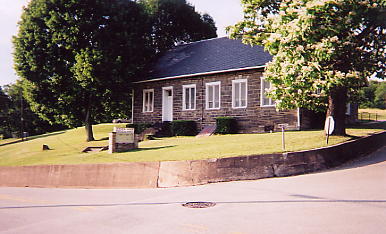
DUNLAP'S CREEK PRESBYTERIAN
CHURCH--near New Salem, PA became the pulpit for
Dr. Jacob Jennings
in 1792. Church services continue to the present day.
|
A Peregrinating Family
The Jennings migratory
tradition forged another westward surge a generation later. Armed with
strong educations and discipline, the sons of Jacob Jennings entered Ohio
and Indiana, sparking illustrious public service careers. David
(1787-1834) served as Belmont county (Ohio) prosecuting attorney, and
later became a State Senator and a member of the U.S. House of
Representatives. Of his brothers, Obadiah (1778-1832) was a renowned
lawyer in Steubenville, Ohio and later became Andrew Jackson's minister in
Nashville, TN; Jonathan (1784-1834) studied law and
became the first governor of Indiana (1816) later serving several terms in
the U.S. House of Representatives; and Ebenezer, the youngest, who moved to
Washington, PA became a Pennsylvania State Senator. The oldest brother, Samuel Kennedy
Jennings (1771-1854) followed his father’s medical lead, becoming a surgeon
and one of the founders of the Washington Medical College of Baltimore. One of
Jennings’ daughters mothered the famous Henry Alexander Wise (1806-1876)
who became Governor of Virginia (1856-1860), opposed secession and served
as a Brigadier-General in the Confederate Army with distinction at the
Battle of Petersburg, and later urged surrender at Appomattox.
A Revolutionary Spirit
At the outbreak of the
Revolutionary War, no less than nine family heads of households (Jennings)
lived at Southampton, Long Island – descendants of John Jennings
(1617-1686). Formed in the early 1640s as the first English settlement in
New York, rivaling New Amsterdam (Dutch), Southampton had become an
important port and trading center. The British wanted to utilize
Southampton as a staging area for the invasion of New York. There were
many Tories (i.e. Loyalists) among the population, but the Jennings
maintained an "Independent tilt." When the British ordered Israel Jennings
(1745-1830), one of the more prominent family heads to either swear
allegiance to the Crown or give up his home, he elected to relinquish his
property and later migrated to Kentucky, finally settling in Brown County,
Ohio (near Cincinnati) in 1803. Israel Jennings was the maternal
great-grandfather of William Jennings Bryan - The Great Commoner
(1860-1925). 8Israel's son (also Israel
Jenning) migrated to Salem, Illinois.
 |
|
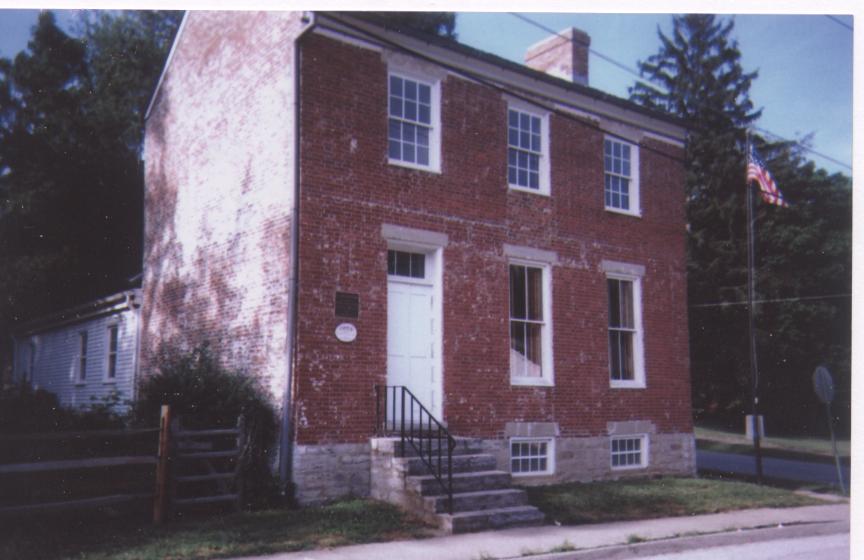
GRANT BOYHOOD HOME - This property, just
off Georgetown, Ohio's main square and less than a mile from the
Jennings farm, was once owned by Jesse Root Grant. His eldest son,
Ulysses S. Grant, learned to ride and work horses in this area.
These "intersections" were discovered during Jennings genealogical
research which linked Israel Jennings (1745-1830) to William
Jennings Bryan (1860-1925). |
________________________________________________________________
Notes and Additional Reading:
1
The Battle of Trenton, Samuel Stelle Smith, 1965, pp. 20-27.
2
1776, David McCullough, Simon & Schuster, 2005.
3
History of Hunterdon and Somerset Counties of New Jersey, James P.
Snell, 1881, p. 30, 218, 228.
4
Early History of Southampton, Long Island, New York, Georges Rogers
Howell, 1887, p. 330-331.
5
History of Fayette County (PA), Ed. Franklin Ellis, 1882, p. 623,
735.
6
Centennial History of Belmont County, OH, A.T. McKelvey, 1903,
p.642.
7
History of Brown County (OH), 1883, p. 379
8
History of Marion County (IL), Prof. J.H.G. Brinkerhoff, 1909, pp.
41, 46, 121.
|
